
Stories
Breaking Barriers: How a Tricycle Is Restoring Falmata's Independence in Borno
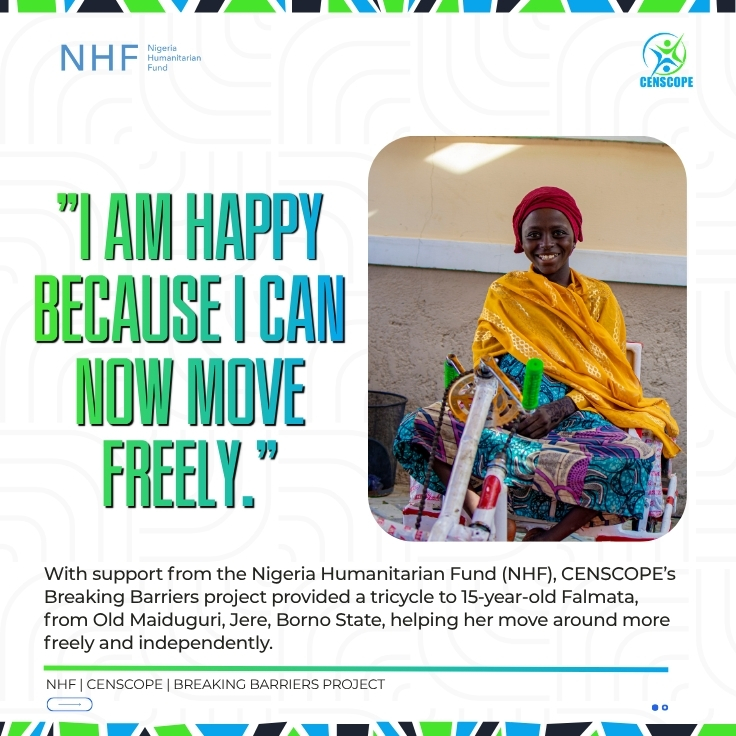
For 15-year-old Falmata from Old Maiduguri, Jere Local Government Area of Borno State, participating in community life is an important part of her daily routine. From attending meetings of her community's Association of Persons with Disabilities to participating in psychosocial support (PSS) sessions and going to her Islamiyya, she values opportunities to connect, learn and engage with others. However, getting to these activities was not always easy. When her previous tricycle became faulty, Falmata's mobility was significantly affected. She increasingly depended on her father to get around. He would carry her on his bicycle to PSS sessions and return later to take her home. Whenever he was unavailable, she had no alternative means of transportation and had to remain at home. Consequently, her ability to participate in activities she valued often depended on her father's availability. Today, that situation is changing. With support from the Nigeria Humanitarian Fund (NHF), the Centre for Social Cohesion, Peace and Empowerment (CENSCOPE), through its Breaking Barriers: Enhancing Safety, Dignity, and Resilience for Persons with Disabilities in the BAY States project, provided Falmata with a new mobility tricycle. The support has made it easier for her to move around and participate in her daily activities with greater independence. She can now attend community association meetings, participate in PSS sessions and go to her Islamiyya without having to rely on her father to transport her everywhere. Recognising the importance of strengthening household resilience alongside individual support, the project also supported Falmata's father with a start-up kit and cash grant. He further participated in financial literacy training to strengthen his capacity to manage financial resources and support his livelihood. These complementary interventions reflect an approach to disability inclusion that considers not only the individual but also the family environment and the economic circumstances that influence their wellbeing. For Falmata, the tricycle represents more than improved mobility. It provides greater freedom to make decisions about her daily activities, maintain social connections and participate in community life. For her family, the livelihood support creates an opportunity to strengthen their economic resilience. Through the Breaking Barriers project, CENSCOPE, with support from NHF, continues to promote dignity, independence, safety and inclusion for persons with disabilities across the BAY States. Because inclusion means ensuring that everyone has the opportunity to participate, connect and live with dignity.